Saturday, 25 June 2011

Younus Khan

YounisKhan1.jpgMohammad Younus Khan (Pashto: محمد یونس خان), (born November 29, 1977 in Mardan, North-West Frontier Province) is a Pakistani cricketer and former captain of the Pakistan national cricket team. Younus' name is often spelled Younis Khan, but he has been quoted as saying, "My name is Younus Khan. I tell people that everywhere, but they don’t listen."[1] He is only the third Pakistani player to score 300 or more runs in an innings.[2]
Pakistan captain Younis Khan announced his retirement from Twenty20 cricket after leading his team to the ICC World Twenty20 title by beating Sri Lanka at Lord's Sri Lanka suffered an 8 wicket thrashing.
"This is my last Twenty20 game [for Pakistan], so I am retiring from T20 internationals," Younis said "I am now 31, I am old for this kind of cricket." No immediate announcement was made as to the identity of his successor as 20-over captain, it was confirmed on July 29, 2009 that Shahid Afridi would succeed him as the Twenty20 Captain.
However after Younus returned to the national setup he announced that he was willing to play Twenty20 cricket for Pakistan as a senior batsman [26] Younus then confirmed that he was available to play in all three-formats of the game. He also announced that he was no longer in the race for the captaincy [27] After announcing his comeback to Twenty20 cricket Younus was selected for the three match Twenty20 series against New Zealand in December 2010. Younus played in all three-matches but struggled for form.In 2008–09, Younus is playing for the Southern Redbacks in Australia's domestic circuit on a short-term basis. He scored a century against Queensland Bulls in the first innings of a Sheffield shield match in Brisbane, which helped the Redbacks to win their first Shield match for a year.

s a senior batsman [26] Younus then confirmed that he was available to play in all three-formats of the game. He also announced that he was no longer in the race for the captaincy [27] After announcing his comeback to Twenty20 cricket Younus was selected for the three match Twenty20 series against New Zealand in December 2010. Younus played in all three-matches but struggled for form.
n 2008–09, Younus is playing for the Southern Redbacks in Australia's domestic circuit on a short-term basis. He scored a century against Queensland Bulls in the first innings of a Sheffield shield match in Brisbane, which helped the Redbacks to win their first Shield match for a year.

Thursday, 23 June 2011

Mohammad Yousuf

Mohammad Yousuf (Punjabi, Urdu: محمد یوسف ; formerly Yousuf Youhana, یوسف یوحنا; born 27 August 1974, Sargodha, Punjab, Pakistan) is a Pakistani right-handed batsman. He is best known in cricket for his achievement in 2006 when he broke the world record for most Test runs in a single calendar year.[2] Prior to his conversion to Islam in 2005, Yousuf was one of only a few Christians to play for the Pakistan cricket team.
On 29 March 2010, Yousuf announced his retirement from all forms of international cricket,[4] just days after the Pakistan Cricket Board imposed an indefinite ban on him. "I received a letter from the PCB that my staying in the team is harmful for the team, so I announce my retirement from international cricket," he said at a press conference in Karachi.[4] On 27 March, Yousuf said that he had decided to retire from international cricket.[23] "Yes, I have decided to retire as Pakistan player and my decision is not an emotional one", Yousuf told press agency AFP, "It's of no use playing if my playing is harmful to the team".[23] He was handed over an indefinite ban by the Pakistan Cricket Board for his disciplinary problems on Pakistan's tour of Australia 2009-2010.
File:Mohammad yousuf.jpgOn 1 August 2010, after Pakistan lost the first Test match against England at Trent Bridge, Nottingham, Yousuf was called back in the squad for the rest of the series.[5] He decided not to play the second test because of tiredness.[24] Shortly after the completion of the second test, Pakistani captain, Salman Butt announced that he expected Yousuf to return for the third test.[25] The selectors decided to play Yousuf in a Tour match against Worcestershire just before the third test so that his form and fitness could be checked [26] Yousuf's form check was positive because on a day inflicted by rain he managed to score 40* [27] Yousuf then scored 56 against England in the 3rd Test before being caught and bowled by Graeme Swann in the process Yousuf became Swann's 100 casualty in Test cricket the day saw a much improved performance by Pakistan as they were eventually bowled out for 308 [28]
In the same tour of England that summer he participated in the Twenty20 series as well. Despite being considered an "old boys cricketer" and having participated in only a sole T20I in 2006 and considered one who does not slog as often (notable by the low amount of sixes he has scored) Yousuf participated and score 26 of 21 deliveries.
e made his Test debut against South Africa at Durban and One Day International debut against Zimbabwe at Harare. He has scored over 9,000 One Day International runs at an average above 40 (2nd highest batting average among Pakistani batsmen after Zaheer Abbas) and over 7,000 Test runs at an average above 50 (highest batting average amongst all Pakistani batsmen) with 24 Test centuries. He has the record of scoring the most runs without being dismissed in the One Day International match, with a total of 405 runs against Zimbabwe in Zimbabwe in 2002-2003. He has also scored a 23-ball fifty and a 68-ball hundred in One Day International. In Test match, he has scored a 27-ball fifty, which is 3rd fastest by any player. He was the top scorer during the successive years of 2002 and 2003 in the world in One Day International match. In 2004, he scored 111 runs against the Australians in the Boxing Day Test. In December 2005, he scored 223 runs against England at Lahore, also earning him the man of the match award. Seven months later in July 2006, when Pakistan toured England, he scored 202 runs and 48 in the first Test, again earning himself the man of the match award. He followed up with 192 in the third Test at Headingley and 128 in the final Test at The Oval.

Mohammad Asif

Mohammad Asif (Urdu: محمد آصف) (born 20 December 1982) is a Pakistani right arm fast medium bowler in cricket. Asif was born in Sheikhupura, and has played first-class cricket for Khan Research Labs, the National Bank, Quetta, Sheikhupura, Sialkot and Leicestershire. He made his Test match debut for the Pakistan cricket team against Australia in January 2005.
In August 2010, the English Sunday newspaper News of the World published allegations that Asif and fellow bowler Mohammad Amir had deliberately bowled no-balls during Pakistan's 2010 tour of England in return for payment from a betting syndicate, a practice known as spot-fixing.[2]
Mohammad Asif.jpgOn September 1, 2010, after the warm-up List A game between Pakistan and Somerset, the International Cricket Council announced that they had suspended Asif under the provision of the provisions of the ICC's Anti-Corruption Code. The statement from the ICC stated that the three players (Asif, Mohammad Amir and Salman Butt) were charged "under various offences under Article 2 of the ICC Anti-Corruption Code for Players and Player Support Personnel relating to alleged irregular behavior during, and in relation to, the fourth Test between England and Pakistan at Lord's last month".[18]
 In 2006, there was a cricket controversy involving Asif, after he tested positive for anabolic steroid, Nandrolone, before having a ban imposed on him overturned on appeal. He was later withdrawn from Pakistan's World Cup squad with an unrelated injury. Further cricket controversy followed when he was detained in Dubai suspected of having drugs on his person and was then found to have tested positive for a banned substance during the Indian Premier League. In August 2010 he was accused by the News of the World of deliberately bowling no-balls in return for payment from a betting syndicate.[2] On February 5th, 2011 a 3-man tribunal, appointed by the International Cricket Council (ICC) gave the verdict that he was to be banned for 7 years, with 2 of those suspended if no further offenses were committed.

Salman Butt

Salman Butt.jpgSalman Butt (Punjabi/Urdu: سلمان بٹ, Salmān Baṭṭ; born 7 October 1984 in Lahore, Pakistan) is a Pakistani cricketer who was a regular Test and ODI left-handed opening batsman. He made his Test debut on 3 September 2003 in the third Test against Bangladesh, and a year later made his ODI debut against West Indies on 22 September 2004. He was appointed captain of the Pakistan Test squad on 16 July 2010. On August 29, 2010, he was implicated in allegations of spot-fixing. As of February 5, 2011, Butt is serving a 10-year ban, of which five years is a suspended sentence.[1]    
After his debut, Butt was dropped and struggled to regain his place due to some stiff competition for the openers' spots. He returned for the Champions' Trophy in 2004 and scored his first fifty for Pakistan in the Paktel Cup against Sri Lanka. In the ODI against India on 13 November 2004, as Pakistan chased down 292, he formed partnerships first with Shoaib Malik, putting on 113, and subsequently with Inzamam-Ul-Haq. Despite having to retire hurt for seven overs due to severe cramp, he returned to steer Pakistan home, finishing on 108 not out.[3]
On 17 July 2010, the Pakistan Cricket Board appointed Butt as captain of the Pakistani Test squad in place of Shahid Afridi, who announced his retirement from Test cricket after Pakistan lost the first test match against Australia.[5] He became the 28th captain of the Pakistani Test team and the fifth to lead them since January 2009.[5]
Yet 2005 saw little improvement, and doubts circulated about his defensive technique, causing him to be shuffled in and out of the side. But things started looking up again during the winter Test series against England, in which he scored a century and two fifties, with a more cautious attitude to his innings building than he had previously shown.[4]

Mohammad Amir

Mohammad Amir (Urdu: محمد عامر, born 13 April 1992), also known as Mohammad Aamer, is a Pakistani international cricketer, whose suspension and subsequent five year ban curtailed his promising career. He is a left arm fast bowler, who opened the bowling in all formats of the game. He made his first-class debut in 2007, and his first One-Day International and Test appearance in 2009 in Sri Lanka, at the age of 17. However, he played his first international match during the 2009 ICC World Twenty20, where he played in every game, helping the national side win the tournament.,[1][2]
Mohammad Amir.jpg
Mohammad Amir (Urdu: محمد عامر, born 13 April 1992), also known as Mohammad Aamer, is a Pakistani international cricketer, whose suspension and subsequent five year ban curtailed his promising career. He is a left arm fast bowler, who opened the bowling in all formats of the game. He made his first-class debut in 2007, and his first One-Day International and Test appearance in 2009 in Sri Lanka, at the age of 17. However, he played his first international match during the 2009 ICC World Twenty20, where he played in every game, helping the national side win the tournament.,[1][2]  
In the initial stages of the 2010 World Cup Amir took three wickets in a five wicket-maiden over in a Twenty20 International match against Australia.[8] The other two men were run out in the same over. This set a world record of three wickets for a bowler in Twenty20 and 5 wickets for a team in one over.Amir was ignored by Pakistan Cricket Board when they awarded cricket contracts to Abdul Razzaq and Mohammad Yousuf, even after his exceptional performance in the 2009 ICC World Twenty20.[9] Later on the Pakistan Cricket Board awarded Amir a 'C' category contract.[10]Amir made his One Day International match debut against Sri Lanka taking 3 wickets at an economy rate of 4.50 and also scoring 23 runs. -On November 9, 2009 he scored 73 runs against New Zealand which is a record for a number 10 batsman. With his batting partner Saeed Ajmal, Amir added 103 runs to Pakistan's chase, only to fall short by 7 runs.[11]

SHOAIB MALIK

Shoaib Malik, Dunedin, NZ, 2009.jpgSHOAIB MALIK (Urdu: شعیب ملک) (born 1 February 1982 in Sialkot) is a Pakistani cricket player. He made his One-Day International debut in 1999 against the West Indies and his Test debut in 2001 against Bangladesh. He has taken over 100 ODI wickets, and has a batting average in the mid 30s in both Test and ODI cricket. His bowling action has come under scrutiny (particularly his doosra) but he has had elbow surgery to correct this. Malik was ranked second, behind teammate Shahid Afridi, in the ICC ODI all-rounder rankings in June 2008.[1] In March 2010, Malik received a one-year ban from international cricket from the Pakistan Cricket Board (PCB); the ban was overturned two months later.[2]
Following Inzamam-ul-Haq's resignation as Pakistan captain after the 2007 World Cup, Malik was put forward as one of the names for the captaincy along with Younis Khan and Mohammad Yousuf. After Younis Khan's rejection, Malik was the popular choice as a younger player and was seen to represent a fresh start after the Inzamam era.
In 2008, media reports in Pakistan surfaced that Malik has married Ayesha Siddiqui, a woman from Hyderabad, India, on 3 June 2002. Malik denied these allegations saying his marriage plans with the woman did not go through, because of a lack of consensus between both the families.[29] In April 2010, Siddiqui's family released Shoaib-Ayesha 'marriage' certificate (Nikahnama).[30] On April 2, 2010, Malik said he plans to sue Siddiqui's family for "indulging in character assassination".[31][32][33] On April 7, 2010 Malik confirmed his marriage with Siddiqui and signed the Talaq (divorce) papers.[34]
Pakistan's coach, Bob Woolmer, was a strong advocate of Malik's case to become captain; in Woolmer's opinion Malik was "the sharpest tactical tack among his group ... a real presence on the field".[16] Former skipper Imran Khan also backed Malik for the role, stating "He appears to have a good cricket brain and could turn out to be a very good choice for Pakistan cricket".[17] Malik was appointed captain on 19 April 2007 by the Pakistan Cricket Board (PCB), his experience considering his relatively young age and consistent performances were cited as other reasons for his appointment.[17] At the age of just 25, he was Pakistan's fourth youngest captain.[16]

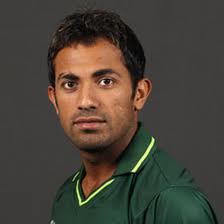
Wahab Riaz

Wahab Riaz (Urdu: وہاب ریاض) is a Pakistani cricketer. He is a left-arm fast-medium bowler and a right-hand batsman. Riaz is a former student of Islamia College, Civil Lines, Lahore.

Riaz was chosen in the squad for the tri-series in Bangladesh which also included India and in his first match against Bangladesh, he finished with 3 wickets for 22 runs in 7 overs and in the next match although he took two Indian wickets he conceded 85 runs.

Wahab made his test debut against England in the third test of the 2010 series. England batted first and Wahab took 5/63 in the first innings. In Pakistan's first innings he came into bat at number 3 and made 27 runs.

He next played for Pakistan in the Test series against South Africa in October 2010 he participated in 4 ODIs. He was selected to play in the first Test later in that series he took two wickets those of Graeme Smith and Hashim Amla however towards the end of the day he picked up a side strain. He did not bowl the following day. A scan showed that Riaz had picked up an injury which takes 4–5 weeks to recover from therefore he missed the rest of the Test series.[1]

In March 2011 he played for the Pakistani Cricket team in at least 4 matches with an above average performance, however he really came in the limelight at the Pakistan Vs India semi-final of the 2011 Cricket World Cup, when he replaced Shoaib Akhtar and took 5 wickets.[2]

In June 2011, he signed for English county side Kent Spitfires as an overseas player for the whole of the 2011 season. He picked up 5 wickets on his Twenty Over debut for Kent.